
Ask The Growth Spec # 2
Answering Reader Questions: Comparing Investments, Finding Stocks, Understanding Price Movements, The AI Bubble, Investment Books and Why Invest.

Hi Folks 👋
Welcome back to The Growth Spec $, the diary of a future holding company CEO.
Introduction
Today we’re bringing you the second installment of Ask The Growth Spec $.
This is valuable because most newsletters keep this kind of engagement behind a paywall but we don’t think that’s right as our readers are part of the journey and should be able to engage with us at no cost.
If you missed the first installment, you can read it here:

Last Sunday we posted the following note:
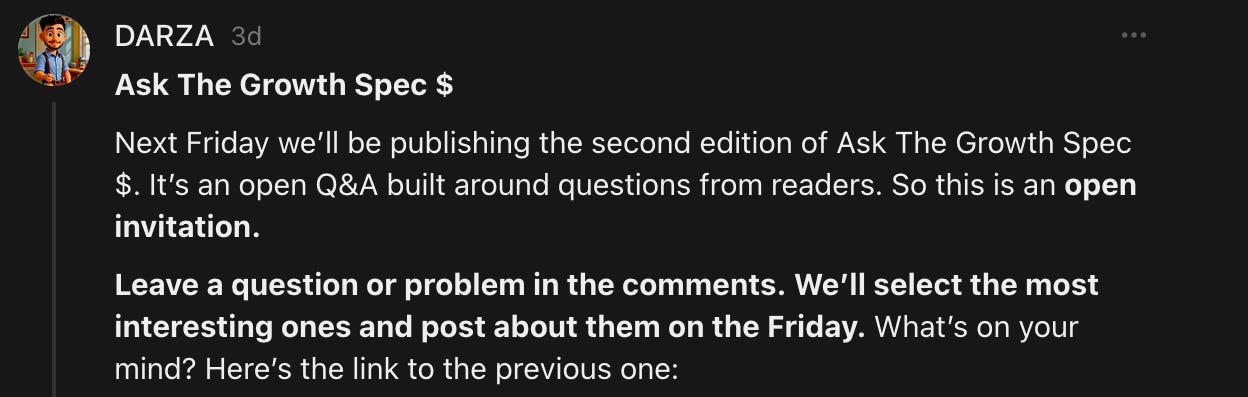
We asked readers to send over their investing questions and today we will be answering those questions.
Responses
A big thank you to everyone who took the time to respond to our note and comment on the previous installment of Ask The Growth Spec $. We really appreciate it! Without you, our humble but ever-growing newsletter would be nothing.
Now let’s dive into it. Below are the snippets of the questions we’ll be focusing on today.






There are a total of six questions we’ll be answering in this installment.
Questions & Answers
Q1. What do you prefer to invest in - Stocks, bonds or Funds?
Answer 1:
We prefer to invest in stocks because they have the potential to provide higher returns over the long term. However, stocks, bonds and funds are all different types of investments, and each has its own advantages and disadvantages.
Stocks are shares of ownership in a company. When we buy stocks, we own a small part of that business. If the company performs well, the value of our shares can increase, and we may also receive dividends. The main advantage of stocks is their potential for high returns, but they are also the riskiest because share prices can rise and fall quickly.
Bonds are loans made to a government or company. In return, the investor receives regular interest payments and gets their original investment back when the bond matures. Bonds are generally less risky than stocks and provide a steady income, but they usually offer lower returns and less opportunity for long-term growth.
Funds are investments that combine money from many investors to buy a mix of stocks, bonds and other assets. This helps spread the risk because the investment is diversified. Funds are also managed by professionals, making them a good choice for people with less experience. However, they often charge management fees, and the returns may be lower than investing in successful individual stocks.
Overall, we would choose to invest in stocks because we are willing to take on more risk for the chance of achieving greater returns over time.
Q2. How do you find stocks to invest in?
Answer 2:
We find stocks to invest in using a variety of different methods. One of the main ways is by reading the work of other investors and discussing ideas with them on platforms such as Substack. This often introduces us to companies we may not have found on our own and gives us different viewpoints to research further.
Another method we use is reading companies’ annual reports. These reports often mention competitors, suppliers or businesses operating in the same industry. This helps us discover other companies that may also be worth researching and comparing.
We also come across investment ideas through our own work (engineering). We are exposed to different companies, technologies and products on a regular basis. If we come across a business that looks interesting, we check whether it is publicly listed and then carry out further research into its financial performance, growth potential and competitive position.
Finally, we often get ideas from everyday life. When we notice a product becoming more popular or hear people talking positively about it, we become curious about the company behind it. If we keep seeing the same brand or hearing good feedback from different people, we will investigate it further.
For example, we recently overheard a child in Farmfoods asking their mum to buy them a can of Celsius because all of their friends were drinking it. Hearing this made us curious about the company, so we found out it was publicly listed and started researching its business, financial performance and future growth potential. This shows how investment ideas can come from everyday observations as well as formal research.

Sometimes it can be all of the above.
Enjoying the content? Don’t miss out on more posts like this. Subscribe to our newsletter and stay updated.
Q3. How can we know if a stock will go up or down?
Answer 3:
We cannot know for certain whether a stock will go up or down, but there are several factors that can influence its movement. The three main factors we consider are market sentiment, company earnings and investor emotions such as fear and greed.
The first factor is market sentiment, which is how investors feel about a company based on news, headlines and rumours. This usually has a bigger impact in the short term. For example, if a company receives positive attention or there is excitement around its future, more people may buy the stock and push the price higher. However, once the excitement disappears, the stock price may fall back. The same can happen with negative news, where a stock may decrease until investors move on from the story.
The second factor is earnings, which relates to how well the actual business is performing. Since a stock represents ownership in a company, a business that is increasing its profits, growing revenue or buying back its own shares may become more valuable over time. This is usually more important for medium to long-term stock performance.
The final factor is fear and greed, which is based on investor psychology. When a stock is rising, people may buy because they believe it will continue increasing, while others may sell because they are worried the price will fall. These emotions can create changes in stock prices that are not always based on the company’s actual performance.
Overall, we believe analysing these factors can help us make better investment decisions, but it is impossible to predict stock movements with complete accuracy.
Q4. What do you think about AI, is it a bubble?
Answer 4:
We do not believe that artificial intelligence (AI) is a bubble, although some AI stocks may become overvalued in the short term. In our opinion, many of the leading AI companies are already generating strong revenues and profits, while also having long-term growth opportunities through new products, partnerships and customer demand. This is different from some past market bubbles, where many of the companies attracting investment were not making any profits or had unproven business models.
That being said, we understand why some investors believe AI is a bubble. When there is a lot of excitement around a new technology, stock prices can rise very quickly. This can cause some companies to become overpriced, and if investor confidence changes, share prices may fall sharply even if the businesses themselves are still performing well.
Our approach is to focus on investing in high-quality AI companies with strong financial performance and good long-term growth potential rather than buying every company associated with AI. We also recognise that short-term price drops are a normal part of investing and can create opportunities to buy more shares at lower prices.
For this reason, we like to keep some cash available instead of investing all of our money at once. If the market experiences a correction or a larger decline, we can use that cash to invest in quality companies at more attractive prices. Overall, we believe AI will continue to be an important technology in the future, but it is still important to be selective and avoid overpaying for investments.
Q5. What investing books do you recommend?
Answer 5:
We have a very large list of books we’d recommend to read if you want to learn investing. However, as a starting point we’d recommend the Intelligent Investor, Common Stocks Uncommon Profits, One Up Wall Street and Zero to One. We’ve actually done book reviews for all of these, you can read them below:


Q6. What got you into investing?
Answer 6:
We first became interested in investing because we wanted to buy a really nice car. However, after spending five years at university, we realised that earning a normal salary alone would not be enough to comfortably afford it without sacrificing other life goals. This made us start thinking about how we could build wealth over time instead of relying only on our income.
That led us to learn more about personal finance, financial literacy and investing. We began reading books, watching educational videos and researching how successful investors grow their money over the long term. The more we learned, the more we realised that investing is not just about trying to get rich quickly. Instead, it is a way of making your money work for you and building financial security for the future.
As we continued learning, our reasons for investing changed. While buying a nice car was what first caught our interest, we now see investing as a way to achieve much bigger goals. It can help us build long-term wealth, prepare for retirement, create financial freedom and have more choices in life. We also one day hope to create a holding company much like Berkshire Hathaway.
Overall, wanting to buy a car was what first introduced us to investing, but gaining a better understanding of financial literacy is what made us continue. It showed us that investing is one of the most effective ways to grow wealth over time and work towards achieving both short-term and long-term financial goals.
That answers the questions raised. We hope you enjoyed reading this installment of Ask The Growth Spec $. We will continue posting more notes to collect questions, and if you have any of your own, feel free to leave them in the comments below.
Best regards,
Darza.
Disclaimer: This article is for informational and educational purposes only and does not constitute financial advice. Nothing in this post should be taken as a recommendation to buy or sell any security. Always do your own research and consult a qualified financial adviser before making any investment decisions.
I wonder how balancing the intrinsic value of a company with the psychological factors driving market behavior could lead to more informed and balanced investment strategies.
Great installment, Darza! The Celsius anecdote is a reminder that some of the best investment ideas are right in front of us in everyday life if we keep our eyes open.
The evolution from wanting a nice car to aiming for a Berkshire-style holding company is awesome.